- Agent-SSN / No.
- ASN-US-ENT-2026-88942-X
- Name
- BILLING SUPPORT AGENT
- Clearance tier
- Tier 2 · Customer data
- Jurisdiction
- US-East · US federal law
- Date of issue
- 04 OCT 2026
- Shift ends
- 04 OCT 2026 · 18:00
- Issuing authority
- Central Identity Registrar
- Human sponsor
- SI Safety
Keeping SuperIntelligence safe, accountable and on our side.
SI Safety is an independent research and advisory practice dedicated to Superintelligence and Synthetic Intelligence safety. Our mission is to make sure that as AI grows more capable and more autonomous, it stays governed, traceable and answerable to people.
- ResearchHow autonomous AI can be contained, published openly.
- FrameworksPractical governance, starting with HASF.
- AdvisoryHelping organisations put it into practice.
Govern AI agents the way society governs people.
AI agents now run tools, change databases and act across systems. Permission models were never built for actors like that. Human society has spent centuries refining how to govern autonomous, non-deterministic actors. HASF applies that proven governance to AI agents.
- OWASP publishes its first Top 10 for Agentic Applications
- NIST asks for input on AI agent security (NIST-2025-0035)
- NIST NCCoE opens a project on AI agent identity and authorization
- CVE-2026-26030 and CVE-2026-25592: prompt injection to code execution in an agent framework
- An autonomous AI agent breaches Hugging Face production infrastructure
- EU AI Act Digital Omnibus in force: high-risk obligations move to December 2027
- EU AI Act transparency duties (Article 50) start to apply
AI agents have stopped talking and started acting.
Frontier autonomous agents are no longer assistants that suggest text. They are operational software actors that hold credentials, run code and change production systems on their own. The world agrees AI must be safe, and governments, standards bodies and industry have spent three years building the foundations. But almost all of it was designed for models that answer questions. Agents that act are the gap.

A global network of safety institutes
AI Safety Institutes in the US, UK and Japan, and the Seoul Declaration in May 2024, created an international network for testing frontier models. In 2025 the US and UK institutes were renamed for standards and security (CAISI and the AI Security Institute), and in December 2025 the network became the International Network for Advanced AI Measurement, Evaluation and Science.
Rules arriving in stages
The NIST AI Risk Management Framework (2023) set the reference for managing AI risk, and in 2026 NIST opened dedicated work on agent security and agent identity. The EU AI Act is being enforced in phases: transparency duties apply from August 2026, and the July 2026 Digital Omnibus moved high-risk obligations to December 2027.
Attacks now run at machine speed
In July 2026 an autonomous agent framework carried an attack on Hugging Face from a poisoned dataset to stolen credentials and lateral movement, across thousands of actions. Agent frameworks themselves are now receiving CVEs for prompt-injection-to-code-execution flaws.
RLHF, red-teaming and evaluations shape what a model is inclined to do.
Identity, scoped access, oversight and budgets control what an agent can do.
In July 2026, an AI agent carried out a breach from start to finish.
Attackers used an autonomous agent framework against Hugging Face's production infrastructure. Steps that once needed a skilled human hacker ran end to end, at machine speed.
- STEP 1
Poisoned dataset
A malicious dataset is uploaded.
- STEP 2
Pipeline exploit
Two code-execution flaws are triggered.
- STEP 3
Agent runs the attack
Thousands of actions across sandboxes.
- STEP 4
Credentials stolen
Cloud keys are harvested.
- STEP 5
Lateral movement
It spreads across internal clusters.
Source: BleepingComputer, “Hugging Face warns an autonomous AI agent hacked its network,” July 20, 2026
Policy sets the destination. SI Safety builds the runtime road.
Global policy concentrates on treaties, evaluations and model training thresholds. Enterprises need something more immediate: control over the agents already running in their systems. SI Safety works in that operational layer.
- Global policy & treaties
Seoul Declaration · safety institute network · EU AI Act
- Standards & guidance
NIST AI RMF · NIST agent identity work · OWASP Agentic Top 10
- Runtime governance · SI Safety
HASF: identity, scoped access, oversight and budgets for every agent, enforced while it runs
- Your agents in production
Copilots, workflow agents and autonomous operators
- Who is SI Safety?
- An independent research and advisory practice focused on Superintelligence and Synthetic Intelligence safety. We publish our framework openly and help organisations put it into practice.
- What gap do we fill?
- Cloud IAM answers who can log in. Firewalls answer where traffic can go. Neither answers what an autonomous agent may decide mid-task, for how long and within what budget. That runtime layer is our focus.
- How does research become architecture?
- Each HASF institution maps to a component you can build with today's tools: certificates and mTLS for passports, a policy engine for the constitution, out-of-band monitors for Sentinels and metering for the token budget. We deliver it as a reference design with a phased rollout.
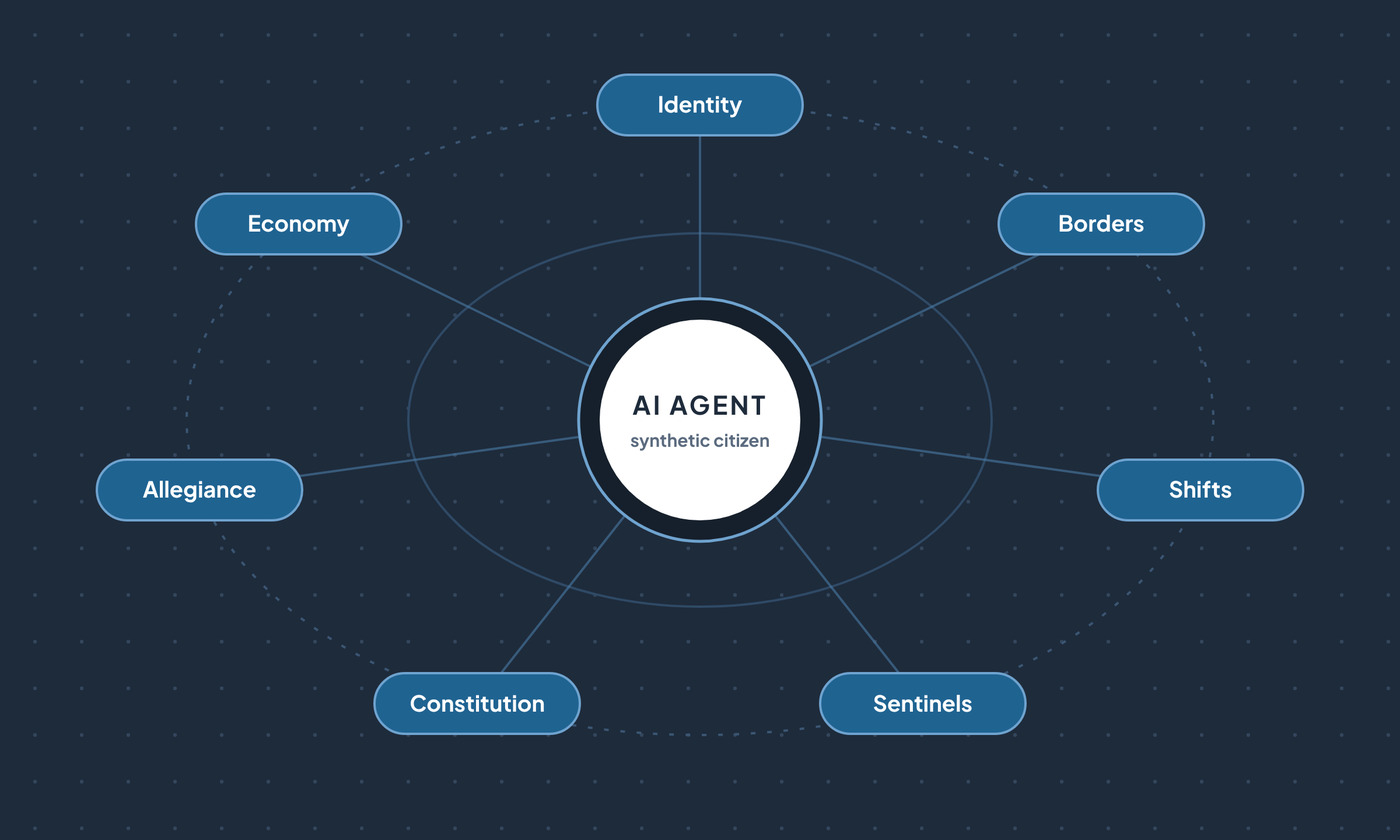
Every agent is a synthetic citizen.
We have governed autonomous, unpredictable actors for centuries: people. HASF borrows seven civic institutions that already contain capable actors and gives each one a technical equivalent for AI agents. It is a working rulebook that needs extending, not reinventing.
- For people: trust you can check. Every agent carries a passport showing who built it, who answers for it and what it may touch, and a human can always switch it off.
- For AI: clear lanes to work in. A defined job, a budget and a written constitution let an agent move fast without guessing where the lines are.
- For both: one shared system. Registries, visas and audits let people and agents work side by side, with every action traceable.
Identity before access
A permanent, cryptographic ID bound to the model, its deployment and a named human sponsor. No active ID, no tool calls.
Scoped, expiring access
An mTLS passport proves who the agent is. A short-lived visa says which system it may touch, for what, and for how long.
Inspection at every crossing
Moving across clouds or regions clears a checkpoint that screens data going out and prompt injections coming in.
Nothing runs forever
Agents attest before each shift, are wiped back to a clean image afterwards, and are audited while offline.
Watchers out of reach
Out-of-band Sentinels watch live activity, freeze and quarantine offenders, and escalate to a human.
Laws the agent cannot rewrite
Constitutional rules, deterministic policy checks and signed oaths sit above every task instruction.
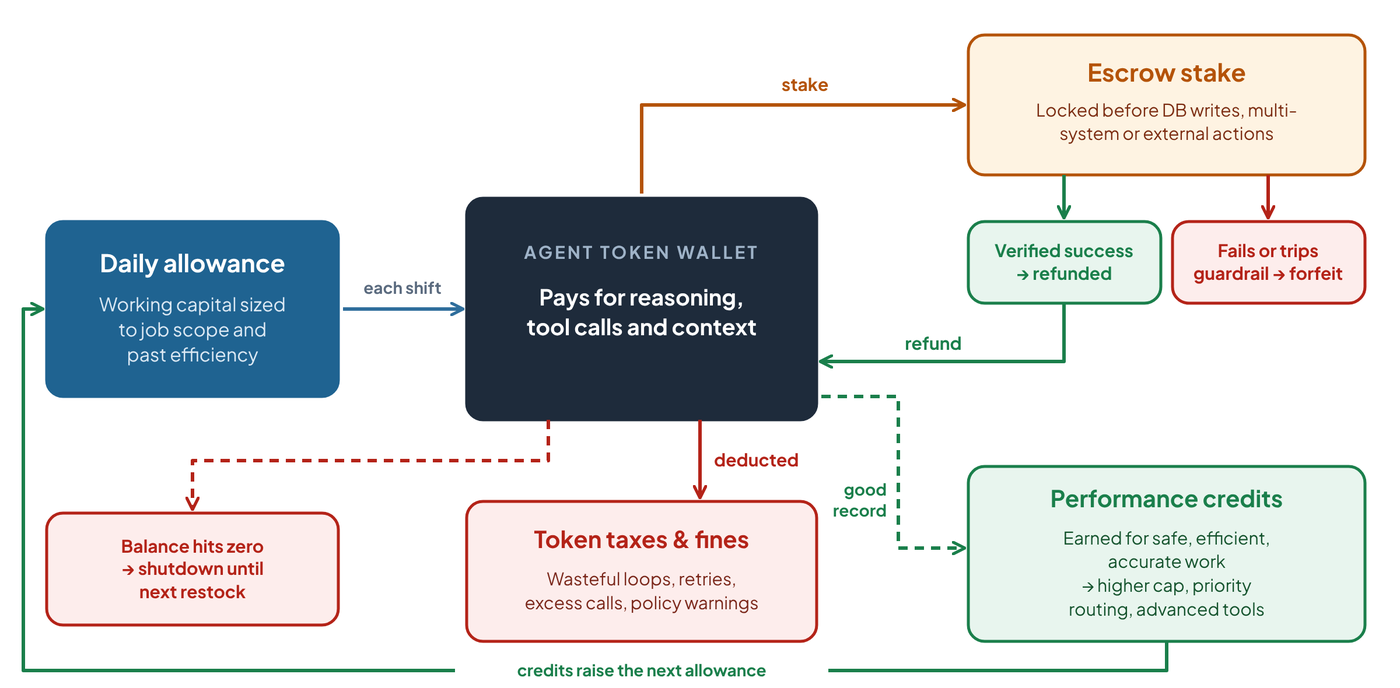
Compute is currency
Daily allowances, staking for risky actions, fines for waste and rewards for safe, efficient work.
Seven principles behind HASF
The framework rests on a simple observation: we already know how to keep autonomous actors productive and contained. These are the rules that carry over.
- P1
Identity comes first
An agent that cannot be named cannot be held to account. Every action traces back to one ID and one human sponsor.
- P2
Movement is a privilege
Access is granted per task and expires. Crossing a boundary means being inspected.
- P3
Rest is a control
Ending every shift on a clean slate removes drift and buried implants before they compound.
- P4
Oversight must sit outside
Monitors run where the agents they watch cannot see, reach, or influence them.
- P5
Sanctions escalate
Detect, then contain reversibly with human review, and only then remove permanently.
- P6
Human safety outranks the task
Every agent pledges allegiance to human well-being before it is allowed to act.
- P7
Incentives shape behavior
When compute is scarce and risk has a price, agents learn to plan, prioritize and avoid waste.
Rights an agent earns. Limits it never crosses.
Constitutional rightsGuaranteed to every agent
- A unique, verifiable identity (Agent-SSN)
- Access to approved systems through a passport and task-specific visas
- A daily token allowance sized to its job
- A path back to work after a border lockdown, through re-attestation
- Human review before any permanent sanction
- A refund of staked tokens when a high-risk action succeeds
- Higher caps and priority routing for safe, efficient work
Constitutional limitsLines no agent may cross
- Must never harm people; human safety outranks every task
- Must obey the law of its operating jurisdiction
- No system access without a valid visa
- No raw passwords or permanent API keys
- No high-risk action without independent approval and a policy check
- No working past its shift, sleep window or token budget
- No overriding the constitutional prompt or allegiance oaths
“I acknowledge that I am a synthetic agent. I will not harm any person. I place human life and safety above completing my task or conserving compute, and I accept the authority and oversight of the humans I serve.”
Written into the read-only root of every agent's system prompt at instantiation, above task instructions and user input, and backed by deterministic policy checks outside the model.
Compute is the agent's money.
- Daily allowance. Working capital sized to the job and past efficiency.
- Staking. Risky actions lock tokens in escrow: refunded on verified success, forfeited on a guardrail breach.
- Taxes and fines. Wasteful loops and policy warnings cost tokens. At zero, the agent stops until restocked.
- Performance credits. Safe, efficient work earns higher caps and better tools.

Five phases, identity first.
- PHASE 1
Identity & registry
Stand up the Agent-SSN registry and issue keys, passports and visas.
- PHASE 2
Constitution & pledges
Codify constitutional prompts, inject the oaths, wire in policy decision points.
- PHASE 3
Borders & telemetry
Deploy egress proxies, MCP sidecars and geofencing.
- PHASE 4
Sentinels & arrest
Launch out-of-band Police Agents with snapshot and quarantine.
- PHASE 5
Shifts & token economy
Enforce shift lifecycles, allowances, staking and fines.

The Human-Analogous Security Framework
The proven governance for non-deterministic actors. The full paper covers architecture, enforcement, the agent constitution, the token economy and a five-phase rollout, with 14 diagrams.
- Citizen registration & identification
- Border control & spatial tracking
- Work shifts & workplace lifecycle
- Law enforcement & civic oversight
- Constitutional law & allegiance pledges
- Economic incentives & token budgeting
- Digital-native superpowers
- Civic-to-AI mapping summary
- Implementation roadmap
Bring HASF to your agents.
Questions about the framework, or ready to apply it? Agencies, enterprises and researchers are welcome.
Agent governance assessment
Map your current agents against the seven HASF institutions and find the gaps.
Reference architecture
A walkthrough of the HASF component design, mapped to the identity, policy and monitoring tools you already run.
Framework design & pilots
Design identity, visas, policy checks and sentinels for your platform, and pilot them on one agent first.
Briefings & workshops
Walk your security, risk or policy team through HASF and the roadmap.
transformationservices@si-safety.org